AntiMicrobial Resistance In Pakistan: Why It Matters and How We Can Stop the Silent Pandemic
Explore why antimicrobial resistance is rising in Pakistan, its human and economic toll,and what

Dr. Ali Danish Alvi
Medical Content Writer
Antimicrobial Resistance in Pakistan: Why It Matters and How We Can Stop the Silent Pandemic
Thousands of people in Pakistan walk into a hospital each year suffering from what should be an easily treatable infection, but the antibiotics prescribed for them are ineffective. Antimicrobial resistance is something that rarely makes front-page news in Pakistan; for professionals, it's close to being yet another boring conference warning, but this is the insidious reality of a crisis already killing more people every year than other epidemics, at least partly in the public consciousness. It becomes the "silent pandemic," as health experts usually name it, because it spreads silently, without front pages, lockdowns, or any kind of scramble associated with infectious outbreaks. Recognizing why this is occurring and how much can genuinely be accomplished about it could be the first stage in reversing the trend.
What Is Antimicrobial Resistance?
Antimicrobial resistance (AMR) is a general term for bacteria, viruses, fungi, and parasites that change over time so that the medicines designed to kill them, antibiotics, antivirals, antifungals, and antiparasitics, no longer work effectively. When this occurs, previously treatable infections become more difficult, costlier, and ultimately untreatable. More than surgery that depends on preventive antibiotics, a world where antibiotics drive resistant infections makes all cancer treatments, particularly those that suppress the immune system, riskier, even childbirth.
In itself, resistance is a natural biological phenomenon but one that is amplified by the inappropriate and excessive use of antimicrobial medicines in humans, animals, and agriculture. A resistant strain of bacteria can transfer from person to person, animal to animal, or from one environment to another, meaning irresponsible antibiotic use in one context is not restricted by geography.
Scale of the Problem in Pakistan
Pakistan is one of the most AMR-hit countries in the world, bearing sobering statistics. Globally, recent data estimate over 264,000 deaths in a single year from bacterial infections in Pakistan alone, of which approximately 160,000 were linked to resistant bacteria and almost 40,000 directly attributable to antimicrobial resistance. The impact on children is greatest: AMR has been linked to tens of thousands of deaths in under-fives and has caused thousands more directly.
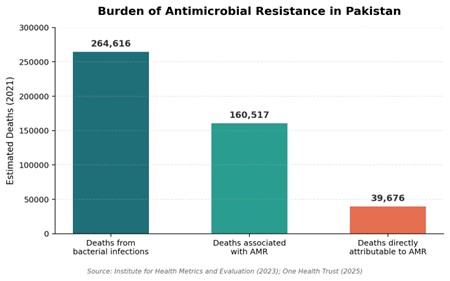
The researchers also warn that waiting too long to step up antimicrobial resistance (AMR) interventions may prove fatal, with AMR-associated deaths in Pakistan on pace to worsen by even more than current trends predict by 2030. The human cost aside, the economic toll is large: infections resistant to treatment mean longer stays in acute care hospitals and more expensive second- or even third-line drugs, as well as lost productivity among patients and their caregivers. A cohort study from two tertiary care hospitals in Islamabad and Rawalpindi revealed that patients with resistant bloodstream infections incurred significantly higher treatment costs than patients whose infections were sensitive to standard antibiotics. The World Bank has also warned that if nothing is done to control AMR, then by 2050 the economies of low-income countries could be reduced to more than 5% of GDP, and an additional 28 million people could be put into poverty in those poor regions.
Why Is AMR Rising So Fast in Pakistan?
Several overlapping factors are driving the rapid rise of resistance across the country.
Easy Access to Antibiotics Without a Prescription
Antibiotics can be obtained without a doctor's prescription in many parts of Pakistan. Studies of pharmacy practices show repeatedly that all kinds of antibiotics, including those meant only for serious infections, are often sold without a proper medical examination. Simulated-client studies indicate that even antibiotics considered to be "Watch" and "Reserve" antibiotic candidates by the World Health Organization are recommended for restricted access. They are available without a prescription. This leads to self-medication, under-antibiotic courses, and wrong drug choices, which hastens resistance.
Overuse and Misuse in Healthcare Settings
Antibiotics are overprescribed and given routinely for viral illnesses in primary healthcare settings where they are ineffective, coupled with poor infection prevention and control practices within hospitals, creating prime conditions for resistant organisms to develop and spread, as we saw. The January DSR reported that the largest proportion of high-level resistance was found in intensive care units (ICU) & surgical wards. Facilities may be overcrowded with constant human activity, leaving less time for staff to adhere rigorously to hygiene and stewardship protocols.
Antibiotic Use in Agriculture and Livestock
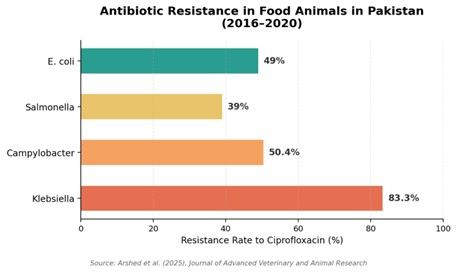
Antimicrobial compound usage is very common in poultry and livestock raising, at times for growth promotion instead of treating sickness. In the case of food animals in Pakistan, a systematic review and meta-analysis has revealed some shocking rates of resistance among common pathogens; for example, Klebsiella isolates proved to have over 80% ciprofloxacin resistance, and E. coli as well as Salmonella showed high rates of resistance against commonly used drugs, including ampicillin and tetracycline. These resistant bacteria can be transmitted to humans from the food chain, water, and environment, especially as these dynamics are better understood through a One Health perspective integrating human, animal, and environmental health.
Weak Surveillance and Limited Laboratory Capacity
Healthcare facilities outside large cities often lack the laboratory capacity to accurately determine whether an organism is resistant. A lack of reliable surveillance data makes it important for clinicians to select an appropriate antibiotic, and it hampers policymakers in tracing how the evolution of resistance patterns is taking place in different regions and pathogens.
What Is Being Done About It?
Pakistan has already made some important initial steps. A National Action Plan on Antimicrobial Resistance was developed in the context of a One Health approach that integrated human, animal, agricultural, and environmental sectors for surveillance operations coordination, regulation of antibiotic sales, and responsible use. Such programs have also been established to strengthen laboratory diagnostic capacity and awareness for prescribers and the public. But evaluations of the implementation of the plan point to uneven progress, especially in agriculture and rural health care settings, and indicate that sustained financing, stronger enforcement of regulations, and improved data collection are essential to achieve substantial national impact.
How Can We Help Stop the Silent Pandemic?
Tackling AMR requires action at every level of society, from individual households to national policy.
What Individuals Can Do
Never take antibiotics for a cold, flu, or other viral illness; they will not help and may cause harm.
Only use antibiotics prescribed by a qualified healthcare provider, and always complete the full course, even if symptoms improve early.
Avoid pressuring doctors or pharmacists for antibiotics "just in case."
Practice good hygiene, including handwashing and safe food preparation, to reduce the risk of infection in the first place.
What Healthcare Providers Can Do
Prescribe antibiotics only when clinically indicated, guided by diagnostic testing where possible.
Follow updated treatment guidelines and antibiotic stewardship protocols within healthcare facilities.
Educate patients on why completing a prescribed course matters and why antibiotics are not appropriate for every illness.
What Policymakers and Institutions Can Do
Enforce regulations restricting the over-the-counter sale of antibiotics without a prescription.
Expand laboratory and surveillance capacity, particularly in underserved regions.
Regulate antimicrobial use in agriculture and livestock more strictly.
Invest in public awareness campaigns that explain, in simple terms, why misuse of antibiotics endangers everyone.
Conclusion
Antimicrobial resistance does not declare itself in the same way as an outbreak, but its effects are just as real and, in Pakistan, so far, are already major, which the figures above show clearly. Every wrongful antibiotic prescription, every treatment course that is never finished, and every livestock dose given without much risk of oversight can only help with a problem that is pretty untraced once established. Taking the edge off will require a concerted effort from individuals, clinicians, and policymakers. We have the tools to tackle AMR; all that is required now is a pledge of steady, national dedication to using these tools in order to prevent the treatable infections of today from becoming tomorrow's untreatable infections.
Frequently Asked Questions:
1. Can antibiotics treat a common cold or flu?
No. Colds and flu are caused by viruses, and antibiotics only work against bacteria. Taking antibiotics for a viral illness will not speed up recovery and only contributes to resistance.
2. Why is it important to finish a full course of antibiotics?
Stopping antibiotics early, even when you start feeling better, can leave behind the hardier bacteria that were not fully eliminated. These surviving bacteria can multiply and develop resistance to the drug that was meant to kill them.
3. Is antimicrobial resistance only a hospital problem?
No. While hospitals are important sites of resistant infections, AMR is also driven by antibiotic use in community pharmacies, agriculture, and livestock. Addressing it requires action across all of these areas, not just within healthcare facilities.
References:
Arshed, M. J., Umair, M., Talib, U., Tahir, M. F., Abubakar, M., Bahadur, S. U. K., Tahmeena, Ullah, R. W., Mohsin, M., Abbas, M. A., Ahsan, Q., Alam, J., & Zaheer, M. U. (2025). Status of antimicrobial resistance in food animals in Pakistan (2016–2020): A systematic review and meta-analysis. Journal of Advanced Veterinary and Animal Research. https://doi.org/10.5455/javar.2025.l930
Safdar N, Saleem S, Salman M, Tareq AH, Ishaq S, Ambreen S, Hameed A, Habib MB, Ali TM. Economic burden of antimicrobial resistance on patients in Pakistan. Front Public Health. 2025 Feb 25;13:1481212. doi: 10.3389/fpubh.2025.1481212
One Health Trust. (2025, November 28). The impact of antimicrobial resistance in Pakistan. https://onehealthtrust.org/publications/infographics/the-impact-of-antimicrobial-resistance-in-pakistan/
Saleem, Z., Hassali, M. A., Godman, B., et al. (2020). Sale of WHO-Aware group antibiotics without a prescription in Pakistan: A simulated client study. Journal of Pharmaceutical Policy and Practice, 13(1), 1–8. https://doi.org/10.1186/s40545-020-00233-3
Safdar, N., Saleem, S., Salman, M., Tareq, A. H., Ishaq, S., Ambreen, S., Hameed, A., Habib, M. B., & Ali, T. M. (2025). Economic burden of antimicrobial resistance on patients in Pakistan. Frontiers in Public Health, 13, Article 1481212. https://doi.org/10.3389/fpubh.2025.1481212
World Bank. (2017). Drug-resistant infections: A threat to our economic future. World Bank Group.
World Health Organization. (2023). Antimicrobial resistance. https://www.who.int/news-room/fact-sheets/detail/antimicrobial-resistance

Suggested Reading
Dengue Fever in Pakistan: Prevention, Early Warning Signs, and Effective Protection
Learn how dengue fever spreads in Pakistan, its early and severe warning signs, and proven ways to prevent mosquito-borne infection at home.

World Pharmacists Day 2026: Strengthening Pharmacists to Make Healthier Futures
World Pharmacists Day 2026 explores FIP's theme of empowering pharmacists, with a firsthand look at their expanding clinical role in Pakistan.